

Scientists Discover Unexpected Physical Clue
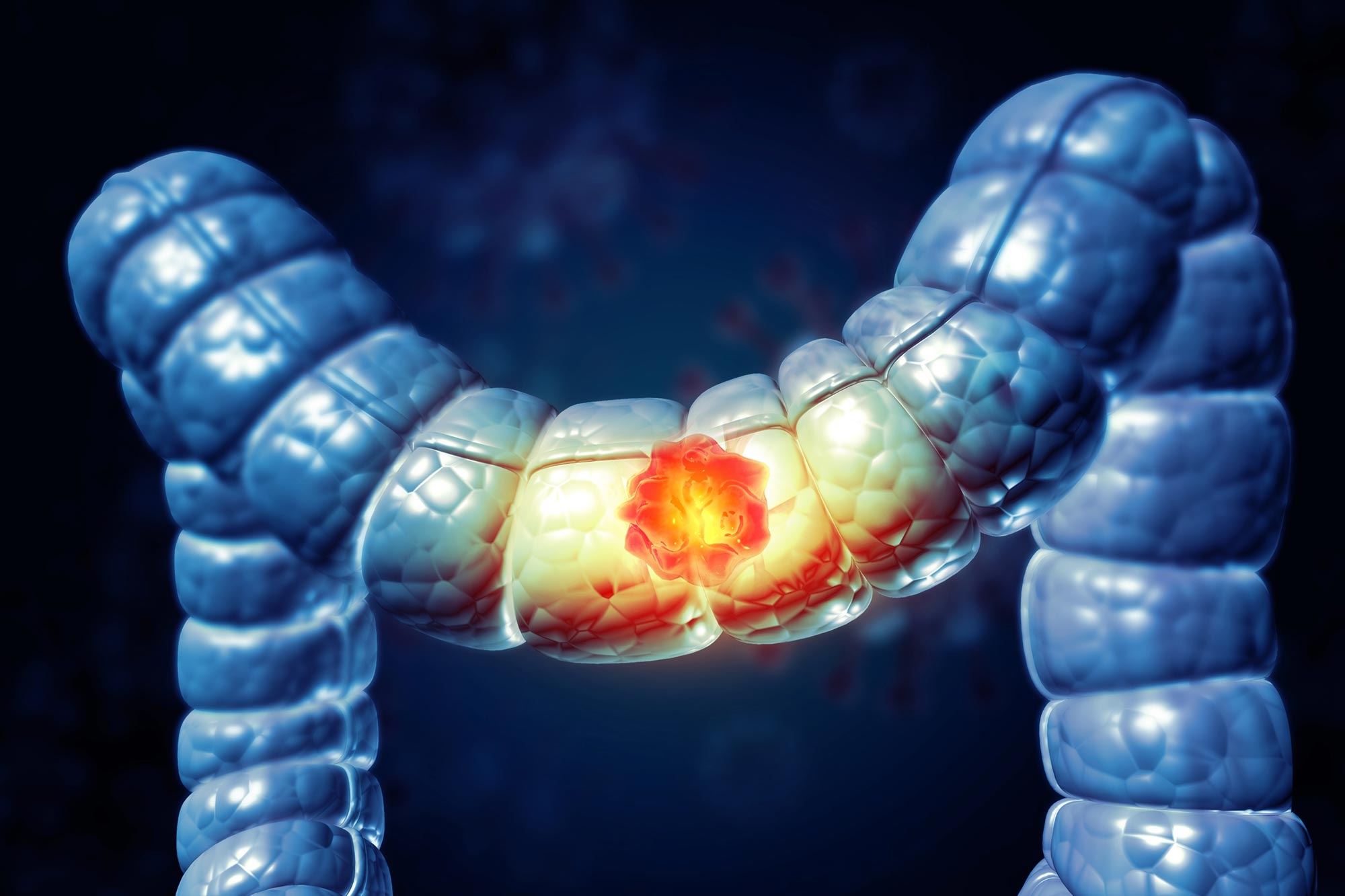
Younger colorectal cancer patients have abnormally stiff colon tissue that promotes tumor growth, pointing to biomechanical forces as a key factor in early-onset disease.
Bioengineers from the University of Texas at Dallas co-led a study that uncovered a striking characteristic in colon tissue taken from younger colorectal cancer patients. Colorectal cancer has historically been considered a disease that mainly affects older adults, but cases among people under 50 have been increasing.
The researchers discovered that both tumor tissue and nearby healthy colon tissue were mechanically stiffer in younger patients compared with older individuals diagnosed with colorectal cancer. Their findings were recently published in Advanced Science.
The results indicate that increased stiffness may create conditions that make it easier for colorectal cancer to develop in people under 50. The work could help guide future strategies to prevent or treat the disease, which is known as early-onset colorectal cancer, a form of the illness that has risen steadily over the past three decades.
“This is the first study to highlight the key role of biomechanical forces in the pathogenesis of early-onset colorectal cancer,” said Dr. Jacopo Ferruzzi, assistant professor of bioengineering in the Erik Jonsson School of Engineering and Computer Science and a corresponding author of the study. The UT Dallas team conducted the research in collaboration with scientists at UT Southwestern Medical Center (UTSW).
Researchers Investigate Causes of Increasing Cancer in Young Adults
“We consider this study a significant advancement toward identifying those at risk of early-onset colorectal cancer and finding new ways to treat them,” said co-corresponding author Dr. Emina H. Huang, executive vice chair of research for surgery at UTSW. She is a professor of surgery and biomedical engineering and focuses on colorectal cancer at the Harold C. Simmons Comprehensive Cancer Center.
Rates of early-onset colorectal cancer have climbed recently. According to the American Cancer Society, it has become the leading cause of cancer-related deaths among people younger than 50 in the United States.
Ferruzzi, who studies biomechanics and mechanobiology, said the project began after Huang noticed patterns in clinical cases.
“Our team brought an engineering mindset to the table to understand the physical mechanisms involved in early-onset colorectal cancer,” Ferruzzi said.
How Colon Structure and Collagen Remodeling Increase Tissue Stiffness
Ferruzzi’s laboratory is based in the Texas Instruments Biomedical Engineering and Sciences Building on the UTSW East Campus. The facility hosts laboratories for both UT Dallas and UTSW researchers and was designed to encourage collaboration between the two institutions.
The colon normally functions as a flexible tube that moves waste through the body using coordinated muscle contractions. Its flexibility can change, however, if the extracellular matrix, a supportive network of collagen within the colon wall, thickens or becomes altered because of inflammation or fibrosis.
To explore this possibility, UT Dallas researchers performed biomechanical tests on tissue samples taken from colorectal cancer patients who were undergoing surgical tumor removal at UTSW. The study included tissue from 19 patients older than 50 with typical onset colorectal cancer and from 14 patients under 50 diagnosed with early-onset colorectal cancer.
Mechanical Testing Reveals Fibrotic, Collagen-Rich Colon Tissue
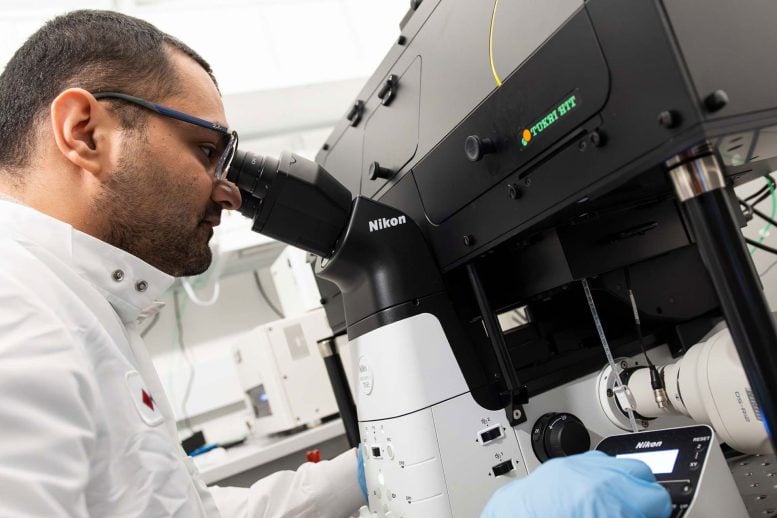
The team used microindentation testing, a method in which a tiny probe presses into tissue to measure how strongly it resists pressure. They also analyzed how the samples responded when compressed. Additional structural and genetic analyses supported the results.
Together, these tests revealed that both cancerous and noncancerous colon tissue from younger patients had fibrotic characteristics, meaning the tissue appeared scarlike and contained higher levels of collagen. Collagen normally helps maintain tissue structure, but excessive amounts can make tissue abnormally rigid.
“We know from previous studies that cancers are usually stiffer than normal tissues,” Ferruzzi said. “While this was true also in patients with early-onset colorectal cancer, we were surprised to find that both healthy and cancerous tissues from these younger patients were stiffer than those from older patients. This led our team to think that such stiffness could be creating a favorable environment for cancer to develop early in life.”
To investigate the potential effects of stiffness, the researchers grew cancer cells on biomaterials designed to mimic the physical characteristics of real tissue. In these experiments, cancer cells placed in stiffer environments multiplied more rapidly, showing that mechanical stiffness can encourage more aggressive tumor growth.
Organoid Experiments Show Stiff Environments Accelerate Cancer Growth
The team also created patient-derived organoids, miniature three-dimensional tissue models that replicate many features of the original organ. These experiments confirmed that when cancer cells are placed in a stiffer environment, they grow faster regardless of whether the cells came from younger or older patients.
Ferruzzi said the findings could eventually help scientists develop new ways to prevent or treat early-onset colorectal cancer.
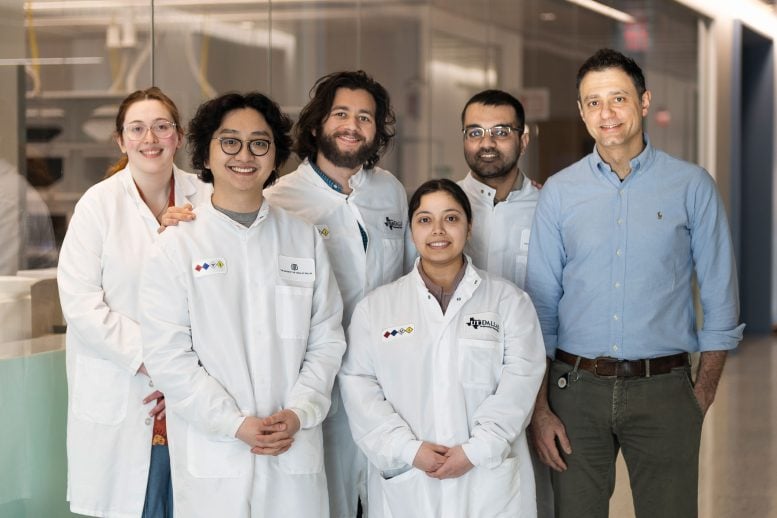
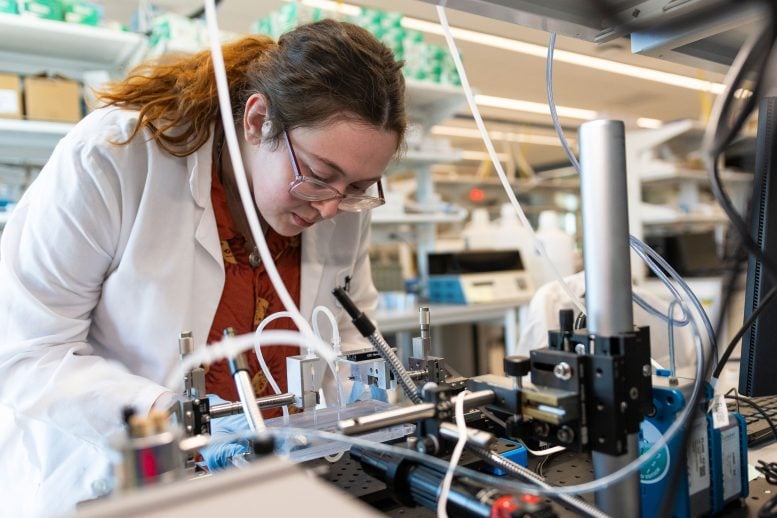
Researchers from UT Dallas and UT Southwestern Medical Center carried out the collaborative study at the Texas Instruments Biomedical Engineering and Sciences Building.
“If we can understand how physical forces fuel colorectal cancer progression, then we can actually think about early diagnosis and, possibly, therapy,” Ferruzzi said. “More importantly, we can ask the question: How do we stop people from developing cancer that early in life?”
Reference: “Biomechanical Phenotyping Reveals Unique Mechanobiological Signatures of Early-Onset Colorectal Cancer” by Nicole C. Huning, Munir H. Buhaya, Victor V. Nguyen, Afeefah Khazi-Syed, Haider A. Ali, Adil Khan, Angela Fan, Robert C. Fisher, Zhikai Chi, Indu Raman, Guangchun Chen, Chengsong Zhu, Mengxi Yu, Andrew R. Jamieson, Sara Roccabianca, Victor D. Varner, Cheryl M. Lewis, Emina H. Huang and Jacopo Ferruzzi, 1 December 2025, Advanced Science.
DOI: 10.1002/advs.202514693
The project was partially funded by the UT Dallas Office of Research and Innovation through a $125,000 Collaborative Biomedical Research Award, a seed grant to encourage interdisciplinary collaborations. Additional support came from the National Institutes of Health (R01CA237304-05, U01CA214300, P30CA142543), the Burroughs Wellcome Fund, the American Society of Colon & Rectal Surgeons, and the UTSW Whole Brain Microscopy Facility.
Never miss a breakthrough: Join the SciTechDaily newsletter.
Follow us on Google and Google News.
Source link
